How Cultural Motif Mosaics Elevate Dubai Luxury Pool Design
In Dubai's luxury property market, a swimming pool is rarely just a place to swim. It is a visual anchor, a gathering point, and often the first thing guests see when stepping into a villa courtyard or onto a Palm Jumeirah terrace. The most memorable pools share one thing: a surface that tells a story. That is where cultural motif mosaics come in. These are not random patterns or simple gradients. They are deliberate compositions that draw on heritage, geometry, and symbolism to create something that feels both personal and timeless.
The idea of embedding meaning into a pool floor is not new. The Mediterranean mosaic tradition, from Roman baths to Moroccan riads, has always used tile to communicate status, belief, or belonging. What has changed is how that tradition is being adapted for the modern Dubai villa. Owners today want a pool that reflects their own story, not just a catalogue design. And the best way to achieve that is through custom pool tiles that carry a motif rooted in culture.
Why Cultural Motif Mosaics Work in Water
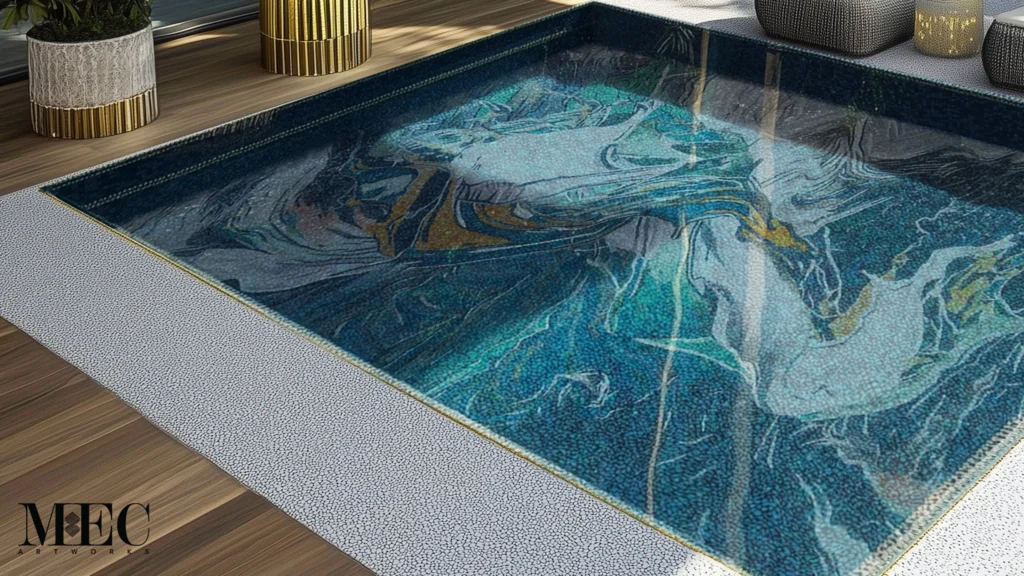
Water distorts and refracts. A pattern that looks sharp on a dry showroom floor can become a blurry mess once submerged. That is why experienced mosaic installers think differently about scale, contrast, and colour temperature when designing for a pool. Cultural motif mosaics are particularly effective here because they often rely on repeating geometric shapes or high-contrast outlines, which hold their form underwater better than fine detail or photographic imagery. Think of a Vitruvian mosaic, where the human figure is contained within a clear circle and square. That structure remains readable even through a foot of moving water.
Another advantage is emotional resonance. A motif drawn from an owner's heritage or travels creates a connection that a generic wave pattern never will. Whether it is a subtle nod to Andalusian tile work or a bold interpretation of Arabic star patterns, the pool becomes a conversation piece. It is also worth noting that these designs are typically executed in hand-cut tiles, which gives the surface a texture and liveliness that machine-cut pieces cannot match. Each tiny chip of glass or stone has its own slight variation, and together they create a mosaic that feels crafted rather than manufactured.
Materials That Make the Motif Last
Not every tile is suited for long-term immersion in chlorinated or saltwater. The materials used for cultural motif mosaics in a pool context need to be dense, non-porous, and colourfast. This is where glass mosaic tiles, particularly Murano glass from suppliers like Bisazza and Sicis, become the go-to choice. Murano glass contains mineral oxides that give it deep, saturated colour, and its surface resists the chemical etching that can dull cheaper tiles over time. For a luxury pool on the Palm Jumeirah or in Emirates Hills, the difference between a standard glass tile and a high-end one becomes obvious after a few seasons of use.
Gold leaf mosaic is another option that has gained traction in Dubai luxury villas. A thin layer of real gold is sandwiched between layers of glass, creating a tile that catches light from every angle. When used sparingly within a cultural motif, it can pick out key elements of the design, the centre of a rosette, the border of a geometric panel, or the eye of a figurative creature. The effect is subtle during the day but striking under evening pool lighting.
Resin-backed mosaics are also worth mentioning. These are tiles that have a fibreglass or resin mesh on the back, which adds structural integrity and makes installation on curved pool surfaces much easier. For a free-form pool with a contoured bench or a vanishing edge, resin-backed sheets allow the installer to follow the shape without cutting individual tiles on site. This is especially useful when the design is complex and the margins for error are thin.
From Wall to Water: Adapting Traditional Patterns
One of the most interesting developments in swimming pool mosaics is the migration of patterns that were originally designed for walls or floors. A traditional pebble mosaic, for example, was once limited to riverbeds and garden paths. Today, with careful selection of smooth pebbles and epoxy grout, the same technique can be used to create a naturalistic pool floor that feels like a freshwater spring. The pebbles are sorted by colour and size, then arranged by hand into a motif, often a fish, a turtle, or an abstract spiral. The result is a surface that is both tactile and visually soothing.
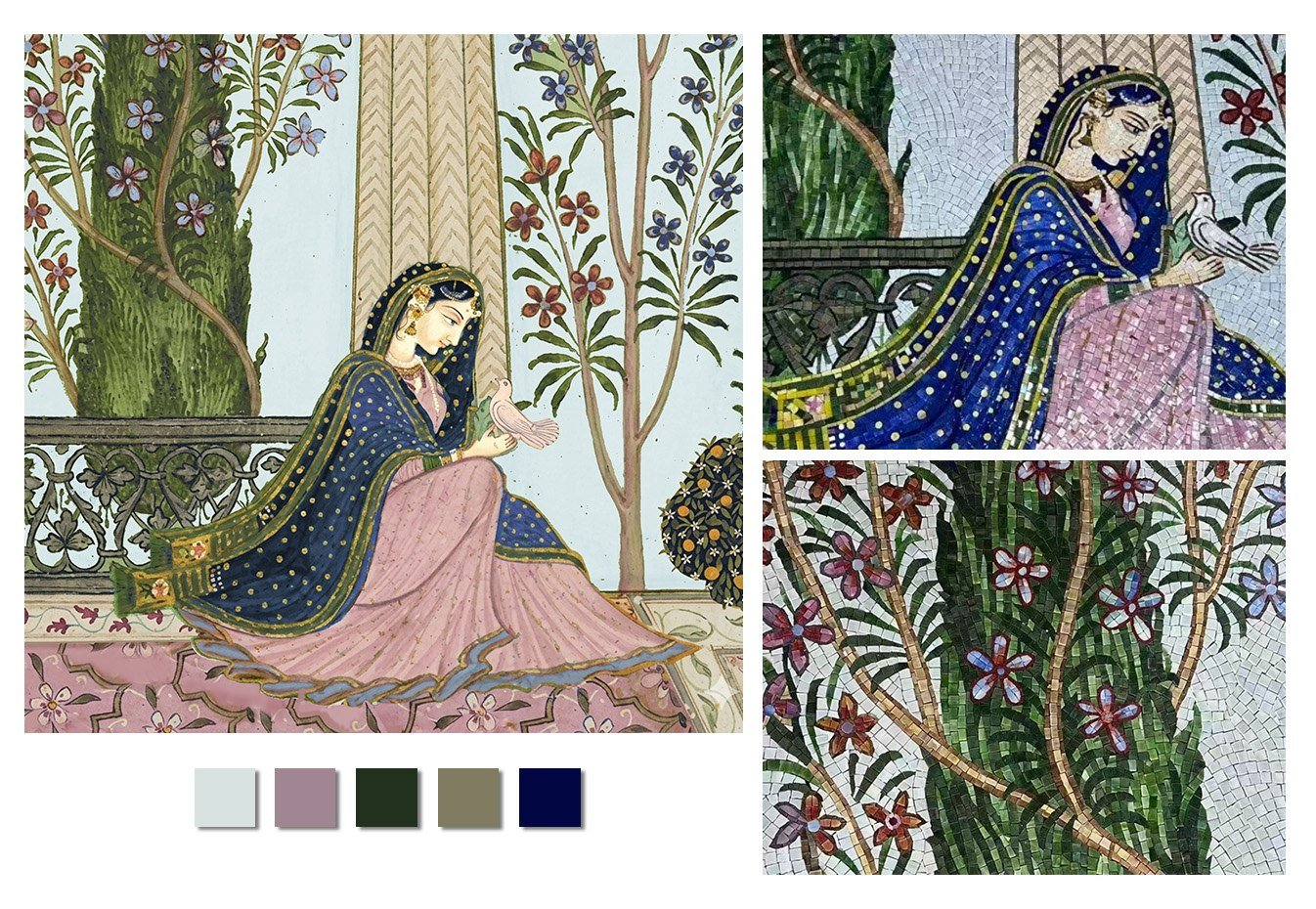
At the other end of the spectrum are the highly polished, reflective designs from Trend Group and similar manufacturers. These companies produce large-format glass panels that can be printed with any image, but the most successful pool installations use those panels sparingly, as accent pieces within a broader field of hand-cut tiles. A single bespoke art panel depicting a traditional dhow or a palm tree can become the focal point of a pool, while the rest of the floor uses a simpler complementary pattern. This approach keeps the design from feeling busy and ensures that the cultural reference remains legible.
Installation Considerations That Matter
Getting cultural motif mosaics into a pool is not a weekend DIY job. The process requires a substrate that is perfectly flat, waterproofed, and cured. Any deviation in the base will telegraph through the tile and ruin the visual alignment of the motif. That is why reputable mosaic installation contractors in Dubai spend as much time on surface preparation as they do on laying the tile. They also pay close attention to expansion joints. A pool deck and pool shell move at different rates as temperatures change, and if the mosaic is not properly isolated from those movements, cracks will appear along the grout lines.
Another factor is the grout itself. For a submerged mosaic, epoxy grout is almost always the right choice. It bonds more strongly than cementitious grout, resists staining, and does not require sealing. The colour of the grout can also be used to enhance the motif. A dark grout will make each tile pop, while a grout that matches the tile colour will create a more seamless look. The decision depends on the specific design and the effect the owner wants to achieve.
Balancing Tradition with Modern Pool Technology
One concern that sometimes comes up is whether a cultural motif mosaic will conflict with modern pool features like LED lighting, heating systems, or automated covers. In practice, these elements can be integrated quite smoothly. LED lights, for instance, can be placed in niches that are lined with the same tile as the rest of the pool, so the light source is invisible during the day. At night, the light travels through the glass tiles and illuminates the motif from below, creating a completely different atmosphere. Heating elements are typically installed beneath the tile, so they have no effect on the visible surface. Automated covers require a track that sits slightly above the waterline, and the tile around the track can be cut to match the surrounding pattern.
The key is to involve the mosaic designer early in the project, before the pool shell is poured. That way, the lighting, plumbing, and structural details can be positioned to support the mosaic rather than fight against it. A water feature design that includes a raised spa or a sheer descent waterfall also needs to be coordinated with the tile layout, so that the motif flows naturally from one element to the next.
The Future of Cultural Motif Mosaics in Dubai
As Dubai's villa market matures, owners are becoming more adventurous with their pool designs. They are moving away from the solid blue or turquoise finishes that were common a decade ago and are asking for something with more personality. Cultural motif mosaics are a natural answer. They allow for infinite variation while staying rooted in techniques that have been refined over centuries. Whether the reference is to Islamic geometry, Venetian glass, or the natural patterns of the Arabian Gulf, the mosaic can be tailored to fit the architecture of the villa and the preferences of the family living there.

The trend is also being helped by advances in digital design tools. Designers can now create a full-scale rendering of a pool mosaic and project it onto a screen for the client to approve before a single tile is cut. This reduces the risk of surprises and gives the client confidence that the final result will match the concept. It also makes it easier to experiment with different colour combinations and tile sizes without committing to a physical sample.
For anyone planning a luxury pool in Dubai, the advice is simple: spend time on the design phase. Look at examples from Bisazza, Sicis, and Trend Group. Visit showrooms that carry Murano glass and gold leaf mosaic samples. Talk to contractors who have done work on the Palm Jumeirah and in Emirates Hills. And most importantly, choose a motif that means something to you. The pool will be there for years. A well-executed cultural motif mosaic will make it a pleasure to look at every single day.